For years, skincare lovers have joked about stuffing their suitcases with sunscreen from France, Korea, Japan, or Australia.
The formulas felt lighter. They wore better under makeup. They didn’t always leave that chalky cast. And, importantly, they often used newer UV filters that American sunscreens simply didn’t have access to.
That changed on June 9, 2026.
The FDA has approved bemotrizinol, also known as BEMT or Parsol Shield, for use in U.S. sunscreens. It is the first new sunscreen active ingredient approved in the United States in more than 25 years.
That may sound like niche skincare news, but it is actually a big public health moment.
Because the best sunscreen is not just the one with the strongest lab data. It is the one people actually want to wear.
What to know in 30 seconds
Bemotrizinol helps protect against both UVA and UVB rays.
It is photostable, meaning it holds up well in sunlight.
It may help brands make sunscreens that feel lighter and more wearable.
Your current sunscreen is not suddenly “bad.” This just means better options may be coming.
So, what is bemotrizinol?
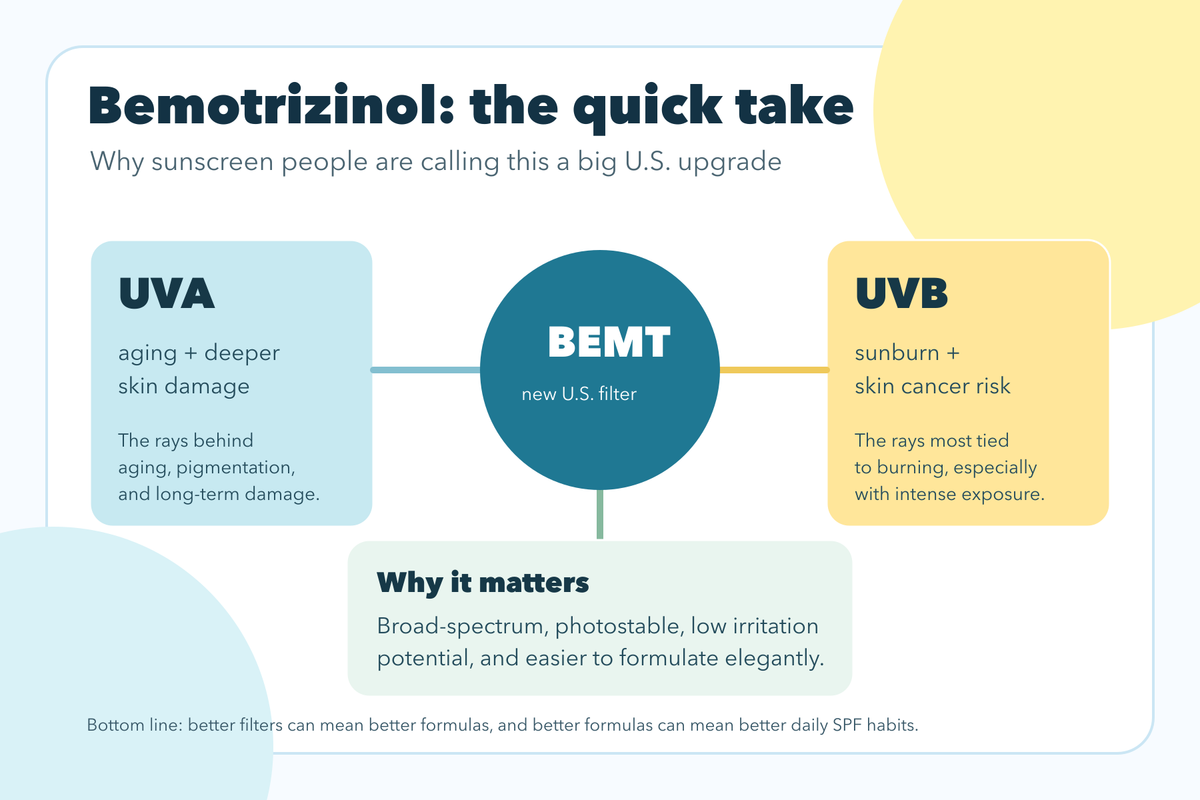
Bemotrizinol is a chemical UV filter, meaning it helps absorb ultraviolet radiation before it damages the skin.
What makes it exciting is that it offers broad-spectrum protection, helping defend against both:
UVA rays: the deeper-penetrating rays linked to premature aging, hyperpigmentation, collagen breakdown, and skin cancer risk.
UVB rays: the rays most responsible for sunburn and also involved in skin cancer risk.
In other words, BEMT helps cover both the “burn” and “long-term damage” sides of sun exposure.
Why is everyone calling this a sunscreen breakthrough?
The U.S. has been behind many other countries when it comes to sunscreen filters.
In Europe, Asia, and Australia, bemotrizinol has already been used for years. But because the U.S. regulates sunscreen as an over-the-counter drug, not just a cosmetic, new filters have faced a much slower approval pathway.
That is why this approval feels so overdue.
American formulators have been working with a relatively limited toolbox for decades, while consumers abroad have had access to more modern filters and more elegant sunscreen textures.
Bemotrizinol is exciting because it is:
Broad-spectrum: It helps protect against both UVA and UVB.
Photostable: It does not break down quickly in sunlight, which is a major advantage compared with some older filters.
Low absorption: FDA review found low levels of skin absorption.
Low irritation potential: Reports note that it rarely causes skin irritation.
Transparent on skin: Unlike many mineral sunscreens, it does not inherently leave a white cast.
Formula-friendly: It may help brands create sunscreens that feel lighter, smoother, and easier to wear every day.
And that last point matters more than people think.
If a sunscreen feels greasy, heavy, sticky, chalky, or impossible to wear under makeup, many people simply will not use enough of it. Or they will skip it entirely.
Better filters can lead to better formulas. Better formulas can lead to better habits.
That is the real win.
Does this mean your current sunscreen is bad?
No.
If you already have a sunscreen you like and use regularly, keep using it.
This approval does not mean older sunscreens suddenly stopped working. Mineral filters like zinc oxide and titanium dioxide remain important options. Existing chemical sunscreens can also provide effective protection when formulated and used properly.
What this means is that U.S. consumers may soon have more options, including formulas that combine strong protection with a better feel on the skin.
That is especially important for people who skip sunscreen because they hate the texture, the eye sting, the residue, or the white cast.
When will bemotrizinol sunscreens be available?
Not instantly.
The ingredient will initially be marketed in the U.S. as Parsol Shield by DSM-Firmenich/DSM Nutritional Products. Reports note an 18-month exclusivity period, with first products expected later in 2026, depending on brand timelines.
So the sunscreen aisle will not transform overnight.
But the door is officially open.
Why this matters beyond beauty
Skin cancer is the most common cancer in the United States, and UV exposure is a major risk factor. Sunscreen is not the only tool, but it is one of the most accessible.
The approval of bemotrizinol means the U.S. sunscreen market can finally start catching up with global innovation.
Better filters can support better UVA protection, better wearability, and, hopefully, better daily use.
This is not just a win for skincare enthusiasts.
It is a win for anyone who has ever said:
“I know I should wear sunscreen, but I hate how it feels.”
The bottom line
Bemotrizinol is not magic.
It does not replace shade, hats, sunglasses, UPF clothing, or reapplying sunscreen every two hours when outdoors.
But it is a meaningful step forward.
For the first time in more than 25 years, the U.S. sunscreen aisle is getting a new active filter. And if it helps make sunscreen feel less like a chore and more like a normal part of getting dressed, that is a very big deal.
The future of American sunscreen may finally be catching up.
I’m curious: what is the biggest reason you skip sunscreen: texture, white cast, eye sting, price, or forgetting to reapply?
A note on sourcing: This post is based on FDA approval materials, dermatology context, and recent coverage of bemotrizinol’s U.S. approval.