How To Start (and Stick With) A Retinoid Without Wrecking Your Skin
The Most Common Retinoid Question I Get
One of the most frequent questions I get asked—both online and in clinic—is:
“What’s the right way to start a retinoid or increase the strength without my skin freaking out?”
Here’s the honest answer: retinoids are irritating when you start them. That part is normal.
What’s not inevitable is quitting them.
With the right approach and a little consistency, that early irritation phase settles down. Your skin adapts. And once it does, you can use a retinoid regularly without irritation—just with better skin: smoother texture, fewer fine lines and wrinkles, improved acne and acne scarring, and more even tone overall.
Aside from sunscreen, retinoids are the single most effective topical ingredient we have for anti‑aging. That’s why I’m such a big advocate for them.
A large portion of my visits are with patients who were prescribed a retinoid, tried it, flared, and gave up. Most of our time together is spent doing something simple but powerful: coaching them through the adjustment phase so they can actually tolerate it long‑term.
Below is the exact framework I use with my patients.
The Goal With Retinoids (Keep This in Mind)
The goal is not redness, peeling, or burning.
The goal is:
Using a retinoid consistently
With little to no irritation
And seeing gradual, real improvement in your skin
If you’re irritated, you’re usually doing too much, too fast—not using the wrong product.
How to Apply a Retinoid the Right Way
1. Use the Right Amount
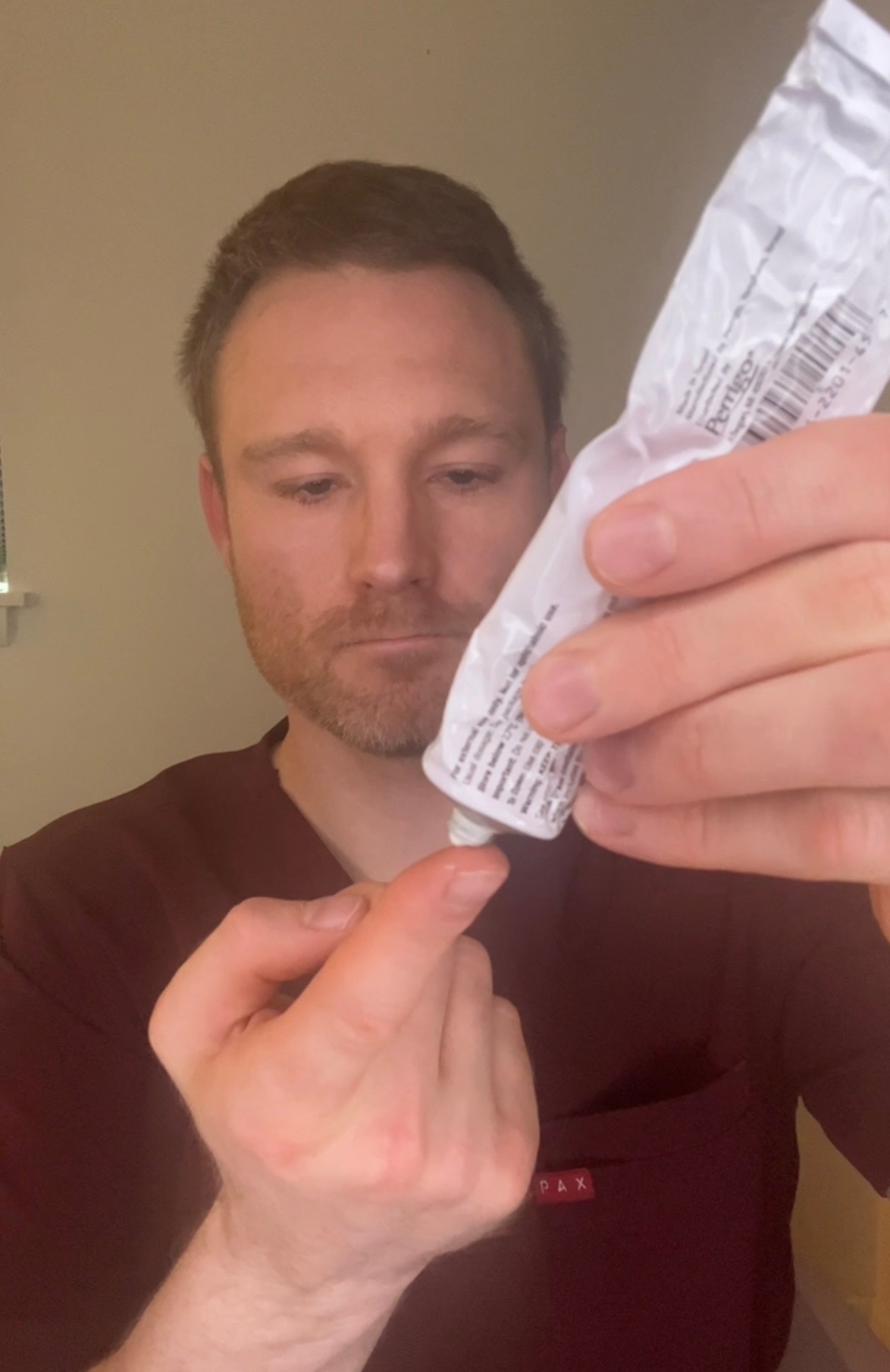
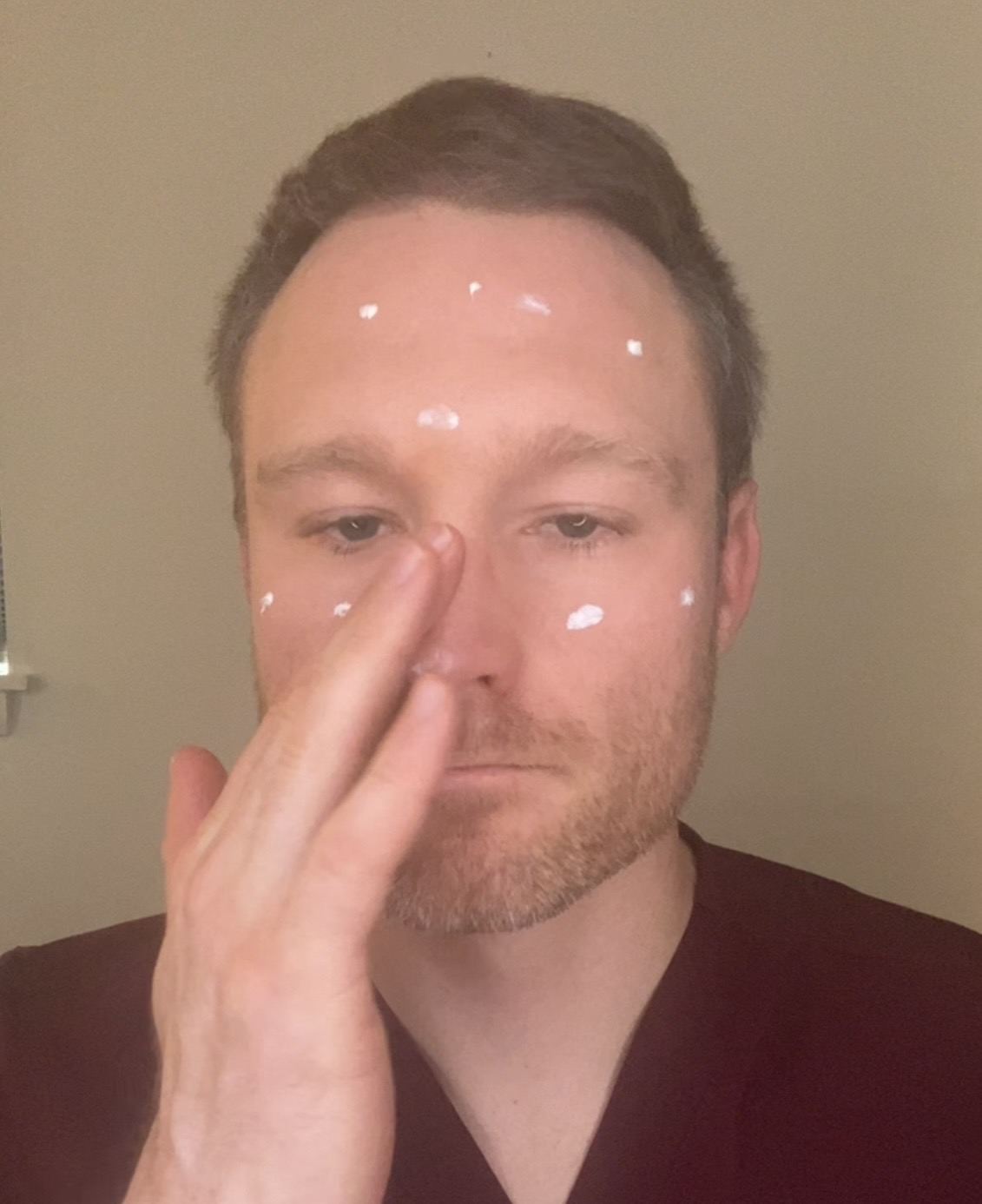
Use one pea‑sized amount for the entire face.
Put that pea on your fingertip, then dot it evenly across your face—forehead, cheeks, nose, chin—before gently spreading it out.
This is not a spot treatment.
Retinoids work by signaling skin cells to behave differently over time, so they should be applied evenly to the entire face (and neck if you want anti‑aging benefits there and your skin can tolerate it).
More product does not mean better results—just more irritation.
2. Start Slow — But Prioritize Consistency
When it comes to retinoids, consistency matters more than anything else.
In most cases, I recommend starting every other night right from the beginning.
You’ll often hear advice to start every three nights. While that can be okay at the very beginning if needed, I generally discourage it long-term. Here’s why:
Many people don’t end up tolerating retinoids because they get irritated, then start spacing applications out so much that their skin never actually adapts.
They’re not failing the retinoid—the retinoid never gets the chance to work.
If irritation is an issue, my preference is not to decrease frequency dramatically, but to:
Keep an every-other-night schedule
And dilute the retinoid with moisturizer (either before, after, or using the sandwich method)
That approach allows your skin to stay exposed often enough to adapt, while still protecting the skin barrier.
If someone truly can’t tolerate every other night at first, starting every three nights is acceptable—but the goal should be to move to every other night as soon as possible.
Getting through this adjustment phase is the most important part of being able to use a retinoid successfully.
3. Apply to Completely Dry Skin
After washing your face, wait 10–20 minutes before applying your retinoid.
Applying retinoids to damp skin dramatically increases penetration—and irritation.
This one change alone fixes a lot of “my skin can’t tolerate retinoids” stories.
4. Moisturizer Is Not Cheating
You can absolutely use moisturizer with your retinoid.
Options include:
Applying moisturizer after your retinoid
Or using the “sandwich method”: moisturizer → retinoid → moisturizer
If moisturizer helps you stay consistent, it’s helping the retinoid work.
5. Expect an Adjustment Phase (But Know the Sensitive Zones)
Mild redness, dryness, and light peeling in the first few weeks can be normal.
What’s not normal:
Burning
Severe stinging
Cracking skin
Ongoing irritation that never improves
It’s also important to know that retinoids commonly cause extra sensitivity in specific areas:
The corners of the mouth
The corners of the nose
Around the eyes
These areas have thinner skin and are more prone to irritation.
The eye area is especially tricky. It’s one of the most sensitive places to use a retinoid—but also one of the most beneficial. Retinoids can help with fine lines and even enlarged sebaceous glands under the eyes.
If you’re using a retinoid near the eyes, go slowly, use very small amounts, and strongly consider buffering with moisturizer.
For people who simply can’t tolerate the most effective retinoids, inactive or gentler retinoid forms are an option. They tend to be less irritating, though they also have less of an effect. Still, they can be a reasonable alternative if stronger retinoids aren’t tolerated.
If irritation is persistent, scaling back strategically is better than quitting entirely.
6. Protect Your Results
Retinoids make your skin more sun‑sensitive, especially early on.
Daily sunscreen is non‑negotiable. If you’re not willing to use sunscreen, a retinoid is going to be much harder to tolerate—and less effective.
Why Consistency Beats Intensity
Retinoids don’t work overnight. They work through repeated signaling over months and years.
That’s why the most successful retinoid users aren’t the ones using the strongest product every night—they’re the ones who:
Use a tolerable strength
Apply it consistently
And stick with it long‑term
That’s when you see the real payoff.
Final Thoughts
If you’ve “failed” a retinoid in the past, chances are you weren’t actually intolerant—you just weren’t guided through the adjustment phase.
Almost everyone can use a retinoid with the right strategy.
And once you get there, it becomes one of the highest‑value steps in any skincare routine.
If you want more practical, no‑nonsense skin guidance like this, that’s exactly what this Substack is for.
Over The Counter Product Recommendations:
Adapalene Link - Great for using before transition to prescription strength retinoids!
Retinol Link - Gentle, less potent than Adapalene. An “inactive” retinoid.
Great EYE serum Link - Gentle, great for around the eyes.