One of the most common moments of confusion I see in clinic goes something like this:
“Wait… why are you prescribing me an anti-dandruff shampoo? I don’t have dandruff.”
Totally fair question.
And the answer surprises a lot of people.
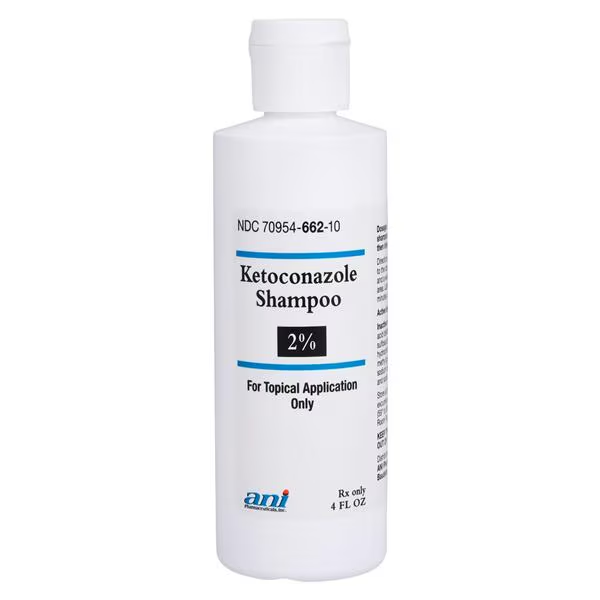
Certain anti-dandruff shampoos—especially ketoconazole shampoo—have consistently shown benefits for hair growth, even in people who have no flakes, no itching, and no history of seborrheic dermatitis.
This isn’t a new idea either. We’ve had evidence supporting this for decades.
A Look Back at a Classic Hair Loss Study
In the late 1990s, researchers began asking an interesting question:
Could ketoconazole shampoo do more than just treat dandruff?
One well-known study followed young men with early male-pattern hair loss, not dandruff. Importantly, none of the participants had been diagnosed with seborrheic dermatitis in the months leading up to the study.
The goal was simple:
Does ketoconazole shampoo influence hair growth in androgenetic alopecia?
What the Researchers Found
Men who used 2% ketoconazole shampoo several times per week experienced:
Increased hair density over time
Noticeable changes beginning around 6 months
Continued improvement for over a year before plateauing
Meanwhile, men using a regular, non-medicated shampoo showed a gradual decrease in hair density during the same period.
Same diagnosis.
Similar ages.
Different shampoo—different outcome.
How Can a Shampoo Affect Hair Growth?
Ketoconazole was originally developed to reduce yeast on the scalp, which is why it works so well for dandruff. But its effects appear to go beyond that.
While we’re still learning the exact mechanisms, several theories exist:
Reduced scalp inflammation around hair follicles
Improved follicular environment, limiting miniaturization
Possible anti-androgen effects, which matter in hormone-driven hair loss
Is ketoconazole a replacement for all our other hair loss treatments?
No.
But as part of a comprehensive regimen, it consistently shows measurable benefit.
How Does It Compare to Minoxidil?
In a much smaller follow-up study, researchers compared ketoconazole shampoo to 2% minoxidil used once daily (which we now know is not optimal dosing).
After six months, both groups showed a similar increase in hair shaft thickness.
Important context matters here:
We now use 5% minoxidil, often twice daily
The study size was very small
Still, the takeaway remains impressive: a medicated shampoo produced structural hair improvements comparable to a classic hair loss treatment—under less-than-ideal conditions.
Why I Recommend It Even Without Dandruff
Hair loss isn’t just about the hair—it’s about the scalp environment.
You don’t need visible flakes to have low-grade inflammation or hormonal signaling that contributes to follicle miniaturization over time. Ketoconazole helps create a healthier baseline for hair follicles to function.
That’s why anti-dandruff shampoos are included in most evidence-based hair loss regimens, even when dandruff isn’t obvious.
Once patients understand that, the recommendation usually clicks.
The Bottom Line
Ketoconazole shampoo:
Isn’t just for dandruff
Has solid evidence supporting hair growth benefits
Works even in classic male-pattern hair loss
Is typically used 1–4 times per week as part of a larger plan
Sometimes the most unassuming tools—like a shampoo—end up playing a much bigger role than people expect.
And yes, it still surprises patients every day.
*Note: these studies were done in males, but females are also affected by androgenetic alopecia and can also benefit from this.
Some over the counter options:
Simple, budget friendly 1% ketoconazole shampoo
REFERENCES:
Piérard-Franchimont C, De Doncker P, Cauwenbergh G, Piérard GE. Ketoconazole shampoo: effect of long-term use in androgenic alopecia. Dermatology. 1998;196(4):474-7. doi: 10.1159/000017954. PMID: 9669136.