As a dermatologist who performs cosmetic procedures, I’ve spent years thinking about a phenomenon that nobody seems eager to discuss. Why do some people who are trying hardest to preserve their appearance slowly drift away from the very thing they’re trying to protect?
This article isn’t about bad fillers or bad doctors. It’s about human psychology, self-perception, and the surprisingly difficult task of knowing when enough is enough.

It’s a question I’ve thought about for years.
As a dermatologist who performs cosmetic procedures, I’ve seen firsthand how powerful aesthetic medicine can be. I’ve seen treatments improve confidence, soften signs of aging, and help people feel more comfortable in their own skin.
But I’ve also noticed something else.
Recently, while sitting in a lecture hall at one of the largest dermatology conferences in the world, I found myself looking around the room and wondering about a phenomenon that nobody seems eager to discuss.
All around me were some of the brightest minds in cosmetic dermatology. Physicians who had spent decades studying facial anatomy, fillers, lasers, surgery, and aging.
And yet some of the people who knew the most about cosmetic procedures seemed to have drifted furthest from the natural appearance they were originally trying to preserve.
Not because they made a terrible decision.
Not because they had a single bad procedure.
But because cosmetic change often happens one small step at a time.
And it made me wonder:
How do intelligent, successful, appearance-conscious people, sometimes even the experts themselves, end up looking different from what they originally intended?
The answer has much less to do with filler itself and much more to do with human psychology.
The Face Nobody Else Sees
One of the strangest things I’ve learned as a dermatologist is how differently patients see themselves compared with how other people see them.
I’ve had patients sit in my chair and point out a wrinkle, asymmetry, shadow, or contour difference that took me several seconds to even notice.
To them, it was all they could see.
To me, it was barely visible.
The longer I’ve practiced, the more I’ve realized that many of us spend far more time studying our own faces than anyone else’s.
We examine ourselves in magnifying mirrors.
We stare at ourselves on Zoom calls.
We take selfies.
We compare ourselves to old photographs.
We analyze every line, every fold, every shadow.
Eventually, we become experts in our own imperfections.
The problem is that when you focus on something long enough, it begins to look larger than it really is.
And the more attention you give a flaw, the easier it becomes to forget that most people never noticed it in the first place.
The Moving Goalpost
Nobody wakes up one day and asks to be overfilled.
That isn’t how it happens.
Someone starts with a little Botox.
Then maybe a syringe of filler.
Then another procedure a year later.
Then perhaps some cheek volume restoration.
Maybe a little jawline definition.
Maybe a touch of lip enhancement.
Each step seems perfectly reasonable on its own.
The problem is that our perception changes as we change.
What once looked dramatic begins to feel normal.
What once felt like enough begins to feel insufficient.
The goalpost moves.
I’ve seen this happen with cosmetic procedures, but I’ve also seen it happen with money, fitness, careers, social media, and countless other areas of life.
The destination keeps changing.
And because the destination keeps changing, satisfaction becomes difficult to reach.
Which raises an uncomfortable question:
How do you know when the problem is truly physical, and when you’ve simply become trapped in an endless search for imperfections?
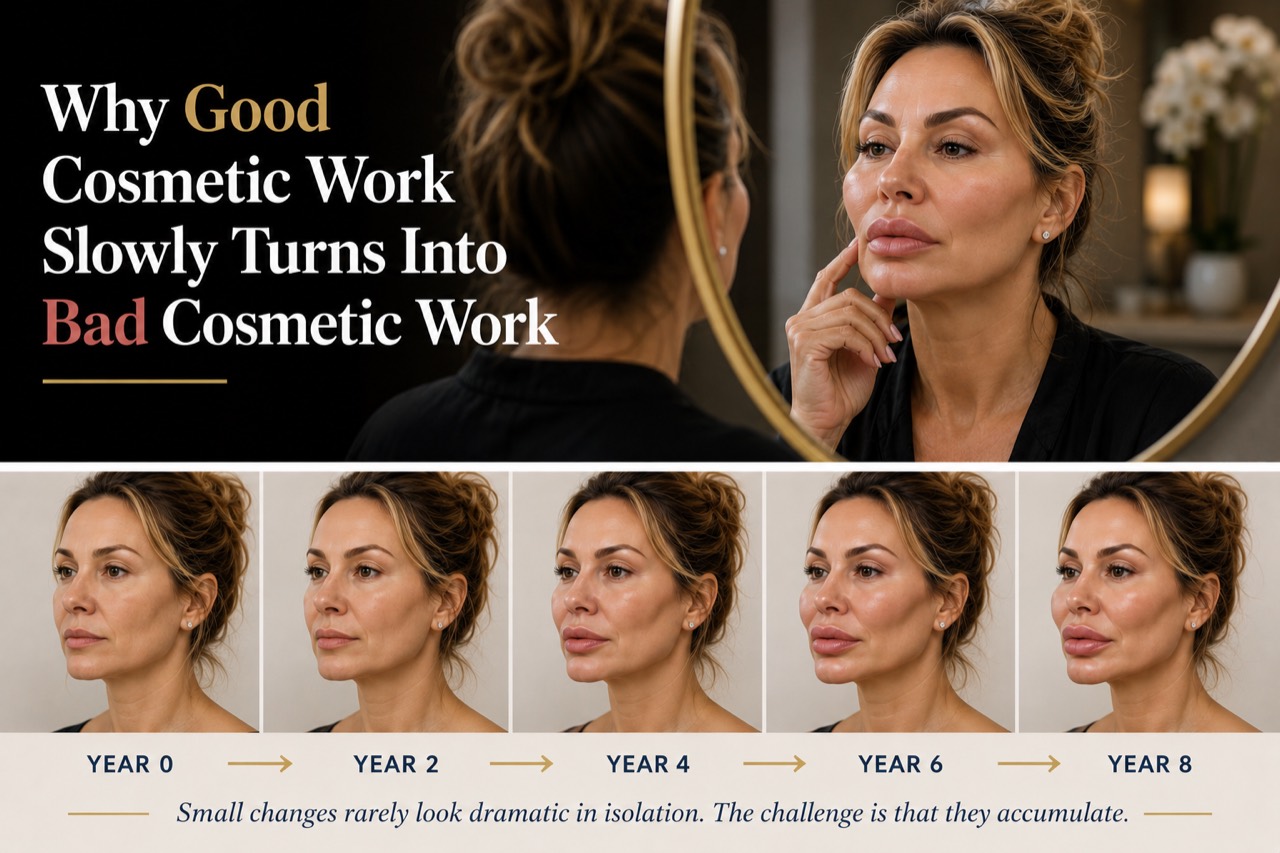
Small changes rarely look dramatic in isolation. The challenge is that they accumulate.
When The Problem Is No Longer Physical
There is a plastic surgeon in my office whose approach has always stuck with me.
Every so often, he’ll see a patient who has become intensely focused on a feature that most people would never notice. It may be a tiny asymmetry, a subtle contour difference, or some other imperfection that occupies far more space in the patient’s mind than it does on their face.
After listening carefully and examining them, he’ll sometimes offer a simple piece of advice:
Go and be happy.
What strikes me about it is not the phrase itself, but the judgment behind it.
He’s not dismissing the patient.
He’s not saying their concern isn’t real.
He’s not saying cosmetic procedures don’t work.
In fact, he’s an excellent surgeon who performs cosmetic procedures every day.
What he’s recognizing is that not every problem requires another procedure.
Sometimes the issue isn’t the feature.
Sometimes the issue is that the person has become trapped in an endless search for imperfections.
And that’s a dangerous place to be.
Because if your happiness depends on finding and fixing every tiny flaw, you’ll never run out of flaws to find.
I think there’s a lesson here that extends far beyond cosmetic surgery.
Many of us spend years believing that the next improvement will finally bring peace.
The next achievement.
The next purchase.
The next promotion.
The next ten pounds lost.
The next milestone reached.
And while improvement can absolutely make life better, there comes a point where the pursuit itself becomes the problem.
The target keeps moving.
The standard keeps rising.
The satisfaction never quite arrives.
What begins as healthy self-improvement can quietly transform into a habit of constant self-criticism.
You stop seeing what’s good because you’re always searching for what’s wrong.
You stop appreciating progress because you’re focused on the gap that remains.
You stop living because you’re busy optimizing.
That doesn’t mean we should stop growing.
It doesn’t mean we should ignore problems that can be solved.
But it does mean we should occasionally ask ourselves an uncomfortable question:
If this issue disappeared tomorrow, would I actually be happy?
Or would I simply find something else to fix?
Some patients appreciate his honesty.
Others eventually find another physician willing to perform the procedure.
But the older I get, the more I appreciate the wisdom in those four simple words:
Go and be happy.
Feature Optimization vs. Face Optimization
One of the biggest mistakes in cosmetic medicine is focusing on individual features instead of the face as a whole.
Patients don’t walk around evaluating each other’s nasolabial folds.
They don’t score each other’s lips.
They don’t measure cheek projection.
They see a face.
They see a person.
A face can have perfect lips, perfect cheeks, and a perfectly defined jawline and still look less attractive than it did before.
Why?
Because beauty isn’t usually found in maximizing every feature.
It’s found in balance.
Think about a symphony.
You don’t improve a song by turning every instrument to maximum volume.
The same is true of the face.
When every feature is optimized independently, the overall harmony can be lost.
Even Cosmetic Doctors Aren’t Immune
The truth is that cosmetic physicians aren’t immune to these forces either.
We spend our days looking at faces.
We spend our careers studying aging.
We notice details that most people would never see.
And while that expertise can be valuable, it can also create its own challenges.
Every cosmetic provider eventually faces the same question:
Am I helping someone age gracefully?
Or am I helping them chase a version of perfection that doesn’t exist?
It’s not always an easy line to draw.
This Is Not An Argument Against Cosmetic Procedures
I perform cosmetic procedures.
I believe in cosmetic procedures.
Some of my favorite outcomes are not dramatic transformations.
They’re the patient who looks less tired.
The patient who feels more confident giving a presentation.
The patient who finally stops thinking about a feature that’s bothered them for years.
Cosmetic procedures can absolutely improve quality of life.
I’ve seen it happen countless times.
Botox can be fantastic.
Fillers can be fantastic.
Lasers can be fantastic.
Surgery can be fantastic.
When done thoughtfully, cosmetic procedures can help people look more rested, refreshed, healthy, and confident.
This article is not an argument against aesthetics.
It’s an argument against excess.
The problem isn’t cosmetic medicine.
The problem is losing the ability to recognize when enough is enough.
Cosmetic procedures can improve your appearance.
They just can’t solve every problem.
And they were never meant to.
The Best Cosmetic Work Is Often Invisible
One of the great paradoxes of cosmetic medicine is that the best work often goes unnoticed.
People may look at someone and think:
You look great.
You look rested.
You look healthy.
They can’t quite identify why.
That’s often a sign that the treatment was successful.
The goal was never to become someone else.
The goal was never to erase every line.
The goal was never to look 25 forever.
The goal was to look like yourself on your best day.
How To Avoid Looking Overdone
The good news is that most unnatural cosmetic results don’t happen overnight.
They happen gradually.
Which means they can often be prevented.
Choose a provider who is comfortable saying no.
One of the most important qualities in a cosmetic provider isn’t technical skill.
It’s restraint.
If your provider never talks you out of a treatment, that’s a red flag.
Focus on your face, not individual features.
Most people don’t notice the tiny details you’re fixated on.
They notice your overall appearance.
The goal should be improving harmony, not chasing perfection.
Compare yourself to old photographs, not filtered faces online.
Your benchmark should be a younger version of yourself, not an unrealistic version of someone else.
Give yourself time between treatments.
Perspective is one of the most valuable tools in cosmetic medicine.
You don’t need to fix everything at once.
Ask yourself one question.
If this concern disappeared tomorrow, would I finally feel at peace?
Or would I simply move on to the next thing I want to fix?
The answer is often surprisingly revealing.
A Final Thought
As a dermatologist, I’ve become increasingly convinced that cosmetic procedures are at their best when they restore perspective, not when they replace it.
The face ages.
That’s what faces do.
The goal isn’t to win a war against time.
The goal is to age well.
To look healthy.
To look vibrant.
To look like yourself.
Because the paradox of cosmetic medicine is that the harder some people chase perfection, the further they drift from the thing they were trying to preserve all along:
Their own face.
And maybe the most underrated advice in cosmetic medicine isn’t a filler technique, a laser treatment, or a surgical procedure.
Maybe it’s those four simple words:
Go and be happy.